Lab 1: Dependency Analysis and Dependency Graph
小组成员
201932110105沈音棋
201932110104马奕琪
201932110106孙仪杰
201932110107田西芷
项目GitHub地址: EnglishPal.
项目Read the Doc地址: Read the Doc.
Abstract
找出EnglishPal中模块/类/函数之间的依赖关系,绘制依赖图,分析EnglishPal当前依赖关系利弊。
Introduction
EnglishPal是智能捕捉阅读弱点,针对性提高用户的阅读水平的网站。提高用户的获取英文信息的速度与准确度。提供精选短文和生词簿,对于英语老师,English Pal 可以帮助掌握题目词汇规律,提高教学质量。对于英语学着,English Pal可以帮助迅速提高词汇,轻松应对各种考试。本次实验针对EnglishPal源代码,分析当前模块级依赖关系以及类/函数级依赖关系,分析当前体系结构。
Methods and materials
①Snakefood:从Python代码中生成依赖,过滤,聚类,并从依赖列表中生成图表。使用Snakefood捕获模块级依赖关系。
②Graphviz:开源的图形可视化软件。使用graphviz online渲染依赖关系图。
③Mermaid:基于Javascript的图表和图表工具,使用文本和代码创建图表和可视化,以便动态地创建和修改图表。使用mermaid live editor渲染类/函数级依赖关系图。
Results
snakefood.dot
# This file was generated by snakefood3.

strict digraph "dependencies" {
    graph [
        rankdir = "LR",
        overlap = "scale",
        size = "8,10",
        ratio = "fill",
        fontsize = "16",
        fontname = "Helvetica",
        clusterrank = "local"
        ]

       node [
           fontsize=12
           shape=box
       ];

"difficulty.py"  [style=filled];
"difficulty.py" -> "wordfreqCMD.py";
"difficulty.py" -> "math";
"difficulty.py" -> "pickle.py";
"main.py"  [style=filled];
"main.py" -> "WordFreq.py";
"main.py" -> "wordfreqCMD.py";
"main.py" -> "UseSqlite.py";
"main.py" -> "pickle_idea.py";
"main.py" -> "pickle_idea2.py";
"main.py" -> "os.py";
"main.py" -> "random.py";
"main.py" -> "glob.py";
"main.py" -> "datetime.py";
"main.py" -> "flask.py";
"main.py" -> "difficulty.py";
"pickle_idea.py"  [style=filled];
"pickle_idea.py" -> "pickle.py";
"pickle_idea.py" -> "datetime.py";
"pickle_idea2.py"  [style=filled];
"pickle_idea2.py" -> "pickle.py";
"pickle_idea2.py" -> "datetime.py";
"UseSqlite.py"  [style=filled];
"UseSqlite.py" -> "sqlite3";
"WordFreq.py"  [style=filled];
"WordFreq.py" -> "wordfreqCMD.py";
"WordFreq.py" -> "string.py";
"wordfreqCMD.py"  [style=filled];
"wordfreqCMD.py" -> "collections";
"wordfreqCMD.py" -> "string.py";
"wordfreqCMD.py" -> "operator.py";
"wordfreqCMD.py" -> "os.py";
"wordfreqCMD.py" -> "sys";
"wordfreqCMD.py" -> "pickle_idea.py";

}
依赖图

mermaid.txt
classDiagram
    WordFreq ..> wordfreqCMD
    wordfreqCMD <.. difficulty
    wordfreqCMD..> pickle_idea
    main ..> wordfreqCMD
    main ..> WordFreq
    pickle_idea ..> pickle
    pickle_idea2 ..> pickle
    Sqlite3Template <|-- InsertQuery
    Sqlite3Template <|-- RecordQuery
    main ..> InsertQuery
    main ..> RecordQuery

    class difficulty{
    +load_record(pickle_fname)
    +difficulty_level_from_frequency(word, d)
    +get_difficulty_level(d1, d2)
    +revert_dict(d)
    +user_difficulty_level(d_user, d)
    +text_difficulty_level(s, d)
}
    class pickle_idea{
    +lst2dict(lst, d)
    +dict2lst(d)
    +merge_frequency(lst1, lst2)
    +load_record(pickle_fname)
    +save_frequency_to_pickle(d, pickle_fname)
    +unfamiliar(path,word)
    +familiar(path,word)
}
    class pickle_idea2{
    +lst2dict(lst, d)
    +deleteRecord(path,word)
    +dict2lst(d)
    +merge_frequency(lst1, lst2)
    +load_record(pickle_fname)
    +save_frequency_to_pickle(d, pickle_fname)
}
    class pickle{

}
    class Sqlite3Template{
    +__init__(self, db_fname)
    +connect(self, db_fname)
    +instructions(self, query_statement)
    +operate(self)
    +format_results(self)
    +do(self)
    +instructions_with_parameters(self, query_statement, parameters)
    +do_with_parameters(self)
    +operate_with_parameters(self)
}
    class InsertQuery{
    +instructions(self, query)
}
    class RecordQuery{
    +instructions(self, query)
    +format_results(self)
    +get_results(self)
}
    class WordFreq{
    +__init__(self, s)
    +get_freq(self)
}
    class wordfreqCMD{
    +freq(fruit)
    +youdao_link(s)
    +file2str(fname)
    +remove_punctuation(s)
    +sort_in_descending_order(lst)
    +sort_in_ascending_order(lst)
    +make_html_page(lst, fname)
}
    class main{
    +get_random_image(path)
    +get_random_ads()
    +total_number_of_essays()
    +load_freq_history(path)
    +verify_user(username, password)
    +add_user(username, password)
    +check_username_availability(username)
    +get_expiry_date(username)
    +within_range(x, y, r)
    +get_article_title(s)
    +get_article_body(s)
    +get_today_article(user_word_list, articleID)
    +appears_in_test(word, d)
    +get_time()
    +get_question_part(s)
    +get_answer_part(s)
    +get_flashed_messages_if_any()
    +highlight(text, word)
    +user_reset(username)
    +mark_word()
    +mainpage()
    +user_mark_word(username)
    +unfamiliar(username,word)
    +familiar(username,word)
    +deleteword(username,word)
    +userpage(username)
    +signup()
    +login()
    +logout()
}
依赖图
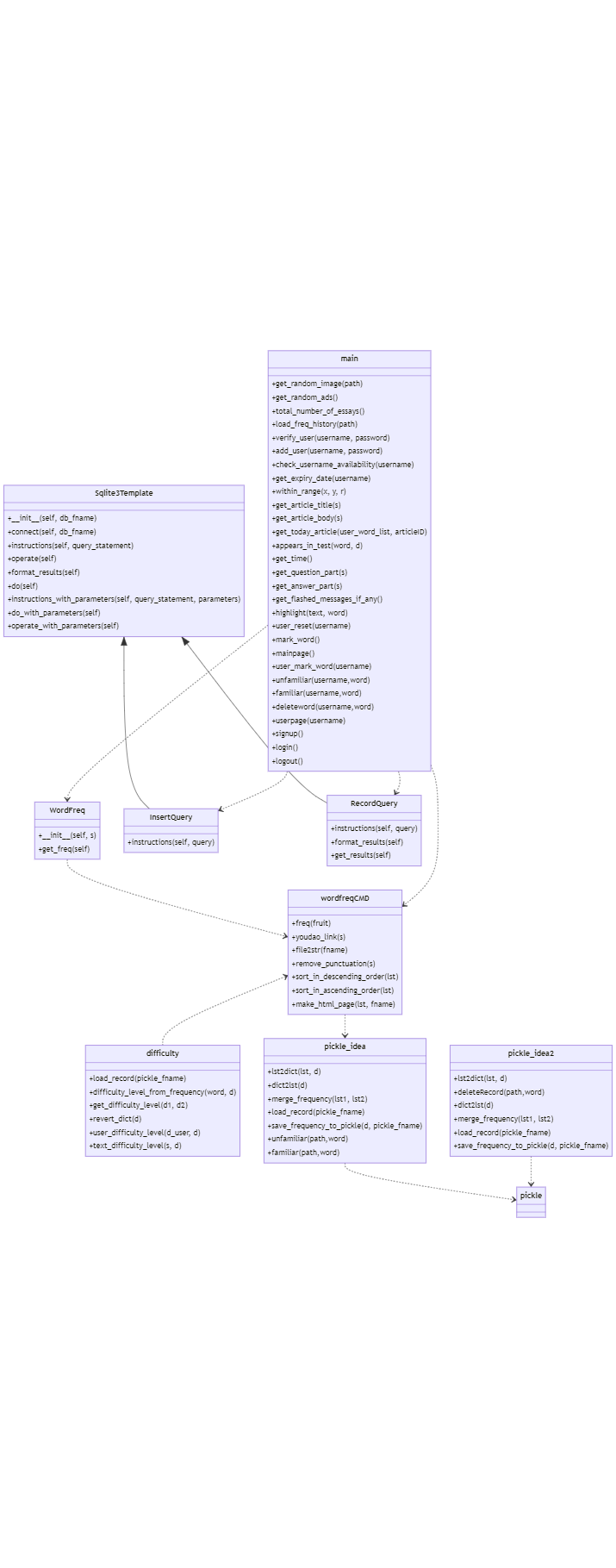
依赖分析:
①wordfreqCMD.py
wordfreqCMD将字符串转换为列表,得到每个单词的词频;wordFreq依赖于wordfreqCMD,初始化文章;difficulty依赖于wordfreqCMD,计算文章的难度等级;main依赖于wordfreqCMD,有道的链接和按降序排列。
②pickle
pickle_idea依赖于pickle,列表llist中的信息存储到字典中,记录单词和词频;pickle_idea2依赖于pickle,列表llist中的信息存储到字典中,记录单词和日期;
将这些函数合并到wordfreqCMD.py中,wordfreqCMD依赖于pickle_idea,显示积累频率。
③UseSqlite.py
Sqlite3Template 连接数据库;InsertQuery继承Sqlite3Template,插入数据;RecordQuery继承Sqlite3Template,记录数据。
④Main.py
获取文章get_today_article,依赖于RecordQuery数据记录、调用方法get_difficulty_level根据读者的阅读水平选择文章、根据pickle_idea2根据记录高亮生词; 显示主页面mainpage,依赖于WordFreq、wordfreqCMD;问题与答案交互方法get_question_part、get_answer_part等; 用户页面,勾选生词userpage,依赖于WordFreq、wordfreqCMD;单词熟悉度操作,包括load_freq_history;unfamiliar;familiar等; 用户注册登录退出signup、login、logout、add_user依赖于InsertQuery。
架构利弊分析
弊端:EnglishPal的主要页面与功能集中在main.py中,功能代码中嵌入了大量网页前端代码,前后端混杂。进行前后端分离的重构有助于解放前端,不需要向后台提供模板,或是在前端html中嵌入后台代码;提高工作效率,分工更加明确;局部性能提升,实现页面的按需加载,在页面交互和用户体验上有所提升;降低维护成本,快速定位问题所在。
优点:前后端之间没有通信成本,功能清晰,无大量重复代码。使用适用于小型网站的Flask框架,使得项目灵活,可扩展性强,第三方库的选择多。
Discussion
通过对EnglishPal的依赖关系分析,对EnglishPal的架构有了清晰的认知。学习使用snakefood生成模块级依赖关系snakefood.dot,并用graphviz渲染;用mermain绘制类/函数级依赖关系图。掌握对已有项目的结构和依赖关系分析方法,对项目重构有更深的认识。
References
[1] Martin Blais, Snakefood User Manual, Copyright (C) 2001-2007